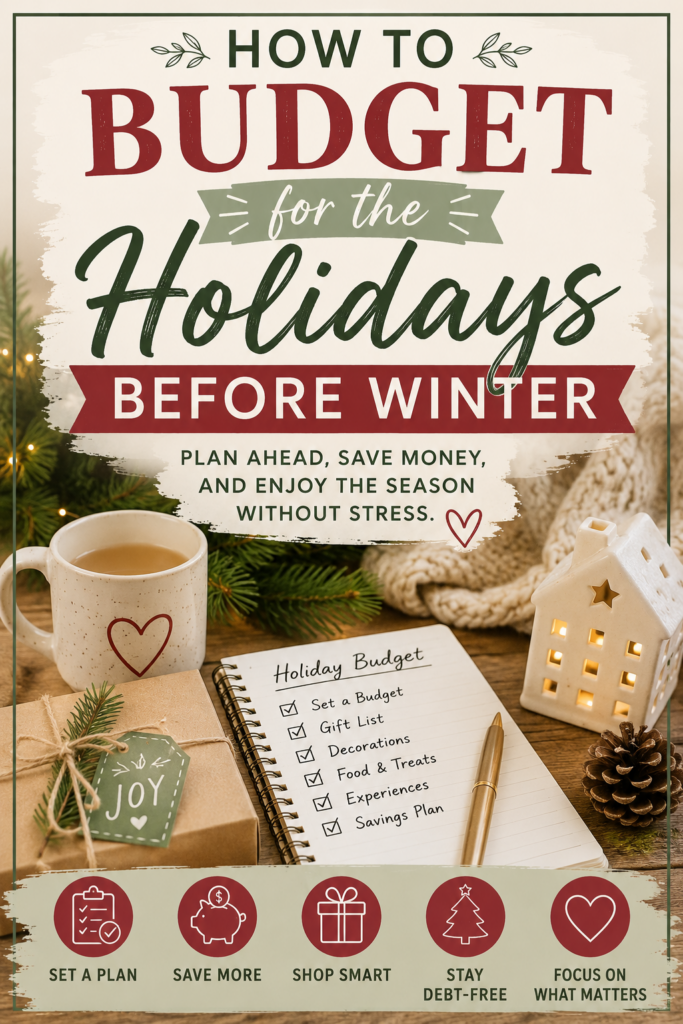
How to Budget for the Holidays Before Winter
Every year Christmas somehow does the exact same thing.
It arrives on December 25th.
Every. Single. Year.
And yet somehow November rolls around and suddenly we’re staring at the calendar thinking:
Wait… Christmas is HOW many weeks away?!
Then come the presents.
Stocking stuffers.
Teacher gifts.
Christmas dinner.
Decorations.
Family activities.
Matching pajamas someone definitely doesn’t need.
Shipping.
Tips.
Cookies.
And approximately 47 “little” purchases that don’t seem expensive until you add them all together.
That’s why one of the best things I’ve started doing is thinking about our holiday budget before winter even begins.
You don’t need to have Christmas completely planned in August or September. You don’t need every gift purchased by Halloween.
But having a plan before the expensive season begins can make a HUGE difference.
So before the first Christmas commercial convinces us that everyone in our lives needs a $75 gift, let’s make a realistic holiday budget.
Why Start Budgeting for Christmas Before Winter?
Because Christmas expenses rarely happen all at once.
They sneak up on you.
A $20 gift here.
A $12 school event there.
$40 at the grocery store because you’re baking cookies.
$25 for a holiday activity.
$15 for wrapping supplies.
Another gift you completely forgot about.
And then suddenly your credit card statement looks like Santa himself borrowed it.
Starting early gives you one thing that’s incredibly valuable:
Time.
If you decide in September that you’d like $800 available for holiday expenses, you have several months to save.
If you realize on December 10th that you need $800?
That’s a very different situation.

Step 1: Decide What You Can Actually Afford
Before making the Christmas list, decide how much money your household can realistically spend.
Not how much you’d like to spend.
Not what you spent last year.
Not what Instagram makes Christmas look like it should cost.
What can you actually afford without creating a financial mess in January?
Maybe it’s $300.
Maybe it’s $500.
Maybe it’s $1,500.
Every family’s number will look different.
The goal isn’t to have the biggest Christmas.
The goal is to enjoy Christmas without still paying for it in March.
Step 2: Make One Giant Holiday Expense List
This is where holiday budgets often go wrong.
We budget for presents.
But Christmas isn’t just presents.
Think about everything you typically spend money on between Thanksgiving and New Year’s.
That might include:
- Gifts
- Stocking stuffers
- Christmas dinner
- Baking ingredients
- Decorations
- Christmas cards
- Postage
- Teacher gifts
- Coworker gifts
- Hostess gifts
- Family photos
- Holiday clothing
- Travel and gas
- Holiday events
- Donations
- Advent calendars
- Wrapping paper
- Tape, bows, and gift tags
- Tips for service providers
- School activities
And don’t forget those random little purchases.
Those are the budget killers.
It’s rarely one giant expense.
It’s usually twenty $10 expenses.
Step 3: Set a Gift Budget Per Person
Once you’ve decided on your overall Christmas budget, divide the gift portion between the people on your list.
This doesn’t mean everyone needs the exact same dollar amount.
You might decide:
Kids: $100 each
Spouse: $75
Parents: $40 each
Teachers: $15 each
Friends: $20
Whatever works for your household.
The important part is giving yourself a limit before you start shopping.
Because without a number, it’s very easy to think:
“Oh, it’s only another $15.”
Do that five times and you’ve added $75 to your Christmas budget.
Step 4: Start a Christmas Sinking Fund
This sounds fancy.
It’s not.
A sinking fund simply means setting aside a little money at a time for a known future expense.
And Christmas is about as predictable as expenses get.
If you want $600 for Christmas and you start saving in September, you could divide that amount between the paychecks you have left before you need the money.
Even $25 or $50 at a time can help.
Put it somewhere separate if possible.
That could be:
A separate savings account
A cash envelope
A designated budget category
The important part is separating it from your regular spending money.
Otherwise your Christmas fund has a funny way of becoming a pizza fund.
Step 5: Look Around Your House Before You Buy Anything
Before shopping for Christmas supplies, go shopping in your own house.
Seriously.
Pull out the Christmas bins.
Check your wrapping supplies.
Look through closets.
Check gift bags.
See what you bought on clearance last year and completely forgot about.
You may already have:
Wrapping paper.
Ribbon.
Gift bags.
Christmas cards.
Stocking stuffers.
Unused candles.
Giftable items.
Decorations.
Boxes.
Tags.
Every item you already own is something you don’t need to buy again.
Step 6: Start Buying Gifts Slowly
One of the easiest ways to avoid a giant December bill is simply not buying everything in December.
Once you have your list and budget, start watching for deals.
August, September, October, and November give you plenty of opportunities to shop.
You don’t have to go crazy.
Maybe you buy one or two gifts per paycheck.
Then cross those names off the list.
By December, you may already be mostly finished.
And that sounds a whole lot nicer than wandering around a packed store on December 23rd.
Step 7: Keep a Christmas Gift List on Your Phone
This saves me from the classic:
“Wait… did I already buy something for them?”
Keep a simple note on your phone with:
Person
Gift idea
Budget
Purchased
Wrapped
And here’s the important part:
Write down where you hid it.
Because buying Christmas gifts early is fantastic until December arrives and you cannot remember where you put them.
Nothing says organized Christmas like finding someone’s present in the back of a closet the following April.
Step 8: Don’t Forget Homemade Gifts
Homemade gifts can be wonderful for keeping Christmas meaningful without buying something for every single person.
And if you garden, homestead, bake, preserve food, or keep bees, you may already have gift-worthy things around your home.
The key is starting early.
A jar of blackberry jam you make in August can become a Christmas present in December.
You’re spreading both the work and the expense across several months.
Step 9: Start Collecting Gift Basket Supplies
Gift baskets can look expensive without actually costing much.
Start collecting baskets, jars, tins, boxes, and other containers before Christmas.
And don’t automatically buy them new.
Check thrift stores.
Reuse baskets you already have.
Save sturdy boxes.
Reuse gift bags.
A $2 thrifted basket filled with homemade jam, honey, bread, and a few inexpensive goodies can make a beautiful family gift.

Step 10: Decide Which Traditions Actually Matter
This is a big one.
Holiday spending often happens because we feel like we’re supposed to do something.
Matching pajamas.
Professional photos.
Expensive light displays.
Elaborate Advent calendars.
Christmas Eve boxes.
Big holiday outings.
None of those things are bad.
But you don’t need to do all of them.
Ask your family:
“What are the three things you really want to do this Christmas?”
You might be surprised.
Maybe the kids care more about driving around looking at Christmas lights with hot cocoa than attending an expensive holiday event.
Maybe everyone wants to bake cookies.
Maybe they love decorating the tree together.
Those traditions can cost almost nothing.
Step 11: Budget for Christmas Food Early
Holiday groceries can get expensive FAST.
Especially if you’re hosting.
Start thinking about your menu before December.
What can you already make from your pantry or freezer?
Do you have:
Frozen berries?
Home-canned jam?
Potatoes?
Squash?
Frozen vegetables?
Homemade broth?
Baking supplies?
Meat in the freezer?
Use what you already have first.
Then start picking up shelf-stable ingredients when they’re on sale.
Butter can often be frozen.
Flour and sugar can be purchased ahead.
Chocolate chips can be bought during sales.
Little by little, you’re spreading the grocery expense over several paychecks.
Step 12: Set a Budget for Stockings
Stockings are sneaky.
You think:
“Oh, I’ll just grab a few little things.”
And then you’ve somehow spent $65 filling one sock.
Set a stocking budget.
Then stick to it.
And remember that stockings don’t have to be filled with expensive toys.
Add practical things your family will use anyway:
Socks.
Toothbrushes.
Favorite snacks.
Lip balm.
Hair accessories.
Pens.
Small toiletries.
Fruit.
Candy.
Things they already need can still be fun to unwrap. I have such fond memories of getting whole nuts and oranges in my stocking as a kid!
Step 13: Use Cash Back, Rewards & Gift Cards You Already Have
Before you start Christmas shopping, check your accounts.
Do you have:
Unused gift cards?
Store rewards?
Credit card rewards?
Cash-back balances?
Loyalty points?
These can sometimes offset holiday purchases.
Just don’t let a coupon convince you to buy something you weren’t going to buy.
Saving 30% on something you don’t need is still spending 70%.
Step 14: Don’t Let Sales Decide What You Buy
Black Friday.
Cyber Monday.
Flash sale.
Doorbuster.
LAST CHANCE.
ONLY THREE HOURS LEFT.
Retailers are very good at creating urgency.
That’s why you make your Christmas list before the big sales begin.
Then when something on your list goes on sale?
Great!
Buy it.
But don’t buy six additional things because the website told you they were an “unbelievable deal.”
Your Christmas budget doesn’t care how good the sale was.
It only cares how much you spent.
Step 15: Consider Experiences Instead of More Stuff
Not every Christmas present needs to be an object.
Especially for kids who already have overflowing toy bins.
Consider:
Movie tickets.
A museum membership.
A zoo trip.
Camping reservations.
A family adventure.
A coupon for a one-on-one date with Mom or Dad.
Experiences can still cost money, but they can also replace several smaller gifts that would otherwise end up forgotten in a bedroom.
Step 16: Give Yourself a Holiday Miscellaneous Fund
No matter how carefully you plan, something will come up.
Someone you forgot to buy for.
A school party.
An unexpected dinner.
A last-minute ingredient.
A gift exchange you didn’t know existed.
Build a little buffer into the budget.
Even $50–$100 can keep those unexpected expenses from throwing off the entire plan.

A Simple Pre-Winter Holiday Budget
Let’s say you’ve decided you can spend $800 total on the holidays.
Your budget might look something like this:
Gifts — $400
Stockings — $75
Food & baking — $125
Activities — $75
Decorations/wrapping — $25
Teacher/neighbor gifts — $50
Unexpected expenses — $50
TOTAL — $800
Your numbers may look completely different.
That’s okay.
The point is that every dollar has somewhere to go before you start spending it.
Start in August If You Can
If you’re reading this while it’s still summer, you’re in a fantastic position.
You have time.
August
Set your total Christmas budget.
Make your gift list.
Start a Christmas savings fund.
Make extra jam or other shelf-stable preserves from the garden for gifts.
Set aside honey or dried herbs.
September
Start buying one or two gifts per paycheck.
Make homemade gifts that need time.
Check thrift stores for baskets and gift containers.
Start watching for sales on things already on your list.
October
Aim to have a good portion of your gifts purchased.
Start collecting holiday baking ingredients.
Finish homemade projects that need curing, infusing, or drying time.
November
Take advantage of sales only for things already on your list.
Finish gift shopping.
Package homemade gifts.
Buy wrapping supplies only if you actually need them.
Finalize your holiday food budget.
December
Ideally?
You’re mostly done.
Now you can focus on fresh homemade gifts, baking, wrapping, family traditions, and actually enjoying Christmas.
That’s the goal.
Not perfection.
Less scrambling.
Remember: Your Kids Don’t Know Your Christmas Budget
This is something worth remembering when the holiday pressure starts creeping in.
Your kids don’t know whether Christmas cost $300 or $3,000.
They remember:
Decorating cookies.
Driving around looking at lights.
Watching Christmas movies.
Waking up excited on Christmas morning.
Making ornaments.
Drinking cocoa.
Playing games.
Having family over.
The magic doesn’t come from the receipt.
Don’t Go Into Debt Trying to Create a “Perfect” Christmas
There is so much pressure during the holidays to make everything magical.
Especially as parents.
But January is coming.
And a “perfect” Christmas isn’t worth starting the new year stressed about credit card bills.
Set a number.
Make the plan.
Buy slowly.
Make some things yourself.
Say no to things that aren’t important.
And remind yourself that enough really is enough.

Budgeting for the holidays before winter isn’t about taking the fun out of Christmas.
It’s actually the opposite.
When you’ve already saved some money, purchased a few gifts, set aside homemade goodies, and decided what you’re comfortable spending, December feels different.
You’re not panicking.
You’re not putting every little purchase on a credit card.
You’re not realizing two weeks before Christmas that you completely forgot about teacher gifts.
Okay…
Maybe we’ll still forget one teacher gift.
We’re only human.
But starting early gives us a chance to create a Christmas that feels intentional instead of expensive.
Start in August or September.
Save a little each paycheck.
Buy gifts slowly.
Use what you already have.
Make some gifts from the garden or homestead.
Choose the traditions your family actually loves.
And when winter finally arrives, hopefully you’ll have more time for the things that make the holidays feel special in the first place.
Because the best Christmas memories usually aren’t the things we bought anyway.